

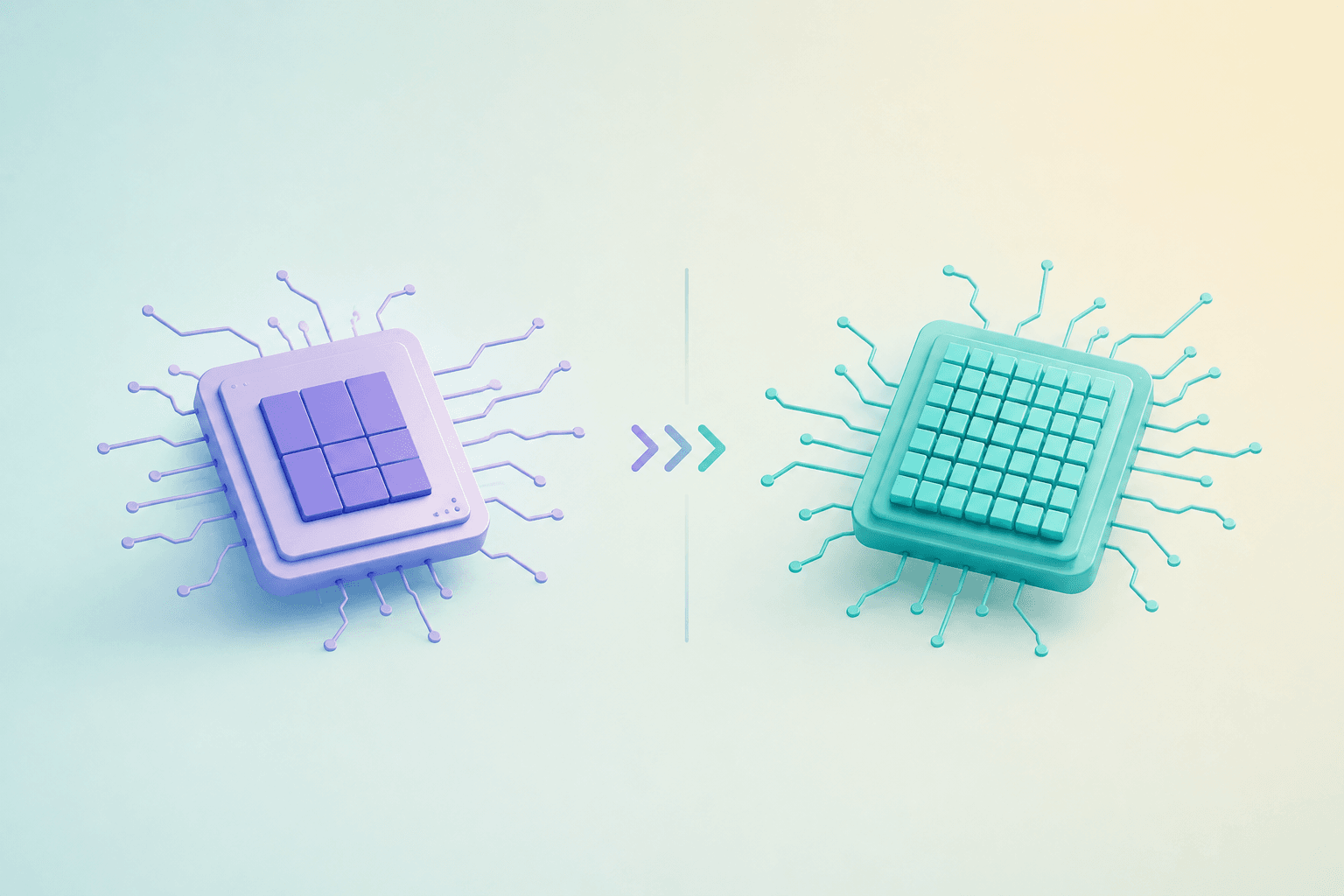
Language Processing Units are worth paying attention to. You know GPUs. LPUs are the newer arrival, and they are turning heads for good reasons.
Speed. Groq has been making waves with their LPU technology, and the results are fast enough to leave GPUs well behind on the workloads they are built for.
Purpose-built for AI. Where GPUs are the jack-of-all-trades of computing, LPUs are specialists, designed from the ground up around the demands of language models and machine learning tasks.
Where the speed actually comes from
The headline claim is easy to be sceptical about, so it is worth knowing what the architecture is doing differently. Two things account for most of it.
The weights live on-chip. GPUs inherited a memory hierarchy designed for training, where HBM is the primary store and the chip fetches weights from it. Every fetch costs hundreds of nanoseconds, and inference is particularly exposed to that because layers run sequentially and there is not much arithmetic per byte loaded to hide the wait behind. The LPU instead uses hundreds of megabytes of on-chip SRAM as the primary weight storage, not as a cache in front of something slower. Groq puts their on-chip bandwidth upwards of 80 TB/s against roughly 8 TB/s for off-chip HBM, and attributes as much as a 10x speed advantage to that difference alone.
Figures published by Groq
Roughly an order of magnitude, and it is the gap Groq attributes much of the speed advantage to. Hover a bar for the value.
| memory | Memory bandwidth (TB/s) |
|---|---|
| LPU on-chip SRAM | 80 |
| GPU off-chip HBM | 8 |
The schedule is deterministic. The Groq compiler places every memory load, operation, and packet transmission at a known cycle. There is no waiting on a cache that has not filled, no resending a packet after a collision, no stalling for memory. A GPU spends real time on exactly those things, and because they are dynamic you cannot schedule around them in advance.
There is also a difference in what gets parallelised. Rather than batching more requests side by side, the LPU splits each layer across multiple chips so that a single forward pass finishes sooner. That is a deliberate trade of throughput for latency, and it is why the architecture suits interactive workloads specifically.
Why it matters
- Faster training times mean more experiments, which means quicker breakthroughs.
- Energy efficiency that is kind to both your budget and the planet. Keeping data on-chip is most of the reason: Groq claims their current generation is 10x more energy-efficient than the most efficient GPU available, because the assembly-line approach minimizes off-chip data movement.
- The potential to unlock AI capabilities we have only been able to speculate about.
The catch
LPUs are still new. Adoption will take time and there is a learning curve involved, which is usually the case with a genuinely different piece of technology.
The architectural trade-offs are real too. On-chip SRAM is fast but there is far less of it than HBM, which is why a large model gets partitioned across many chips rather than fitting on one. And a specialist is a specialist: this is inference hardware for language models, not a general replacement for a GPU that also trains, renders, and runs whatever else you point at it.
If you are in the AI space, or just tech-curious, LPUs are worth keeping an eye on. They may turn out to be the key to the next real leap in machine learning.
Have you had any experience with LPUs? I would be interested to hear it.