

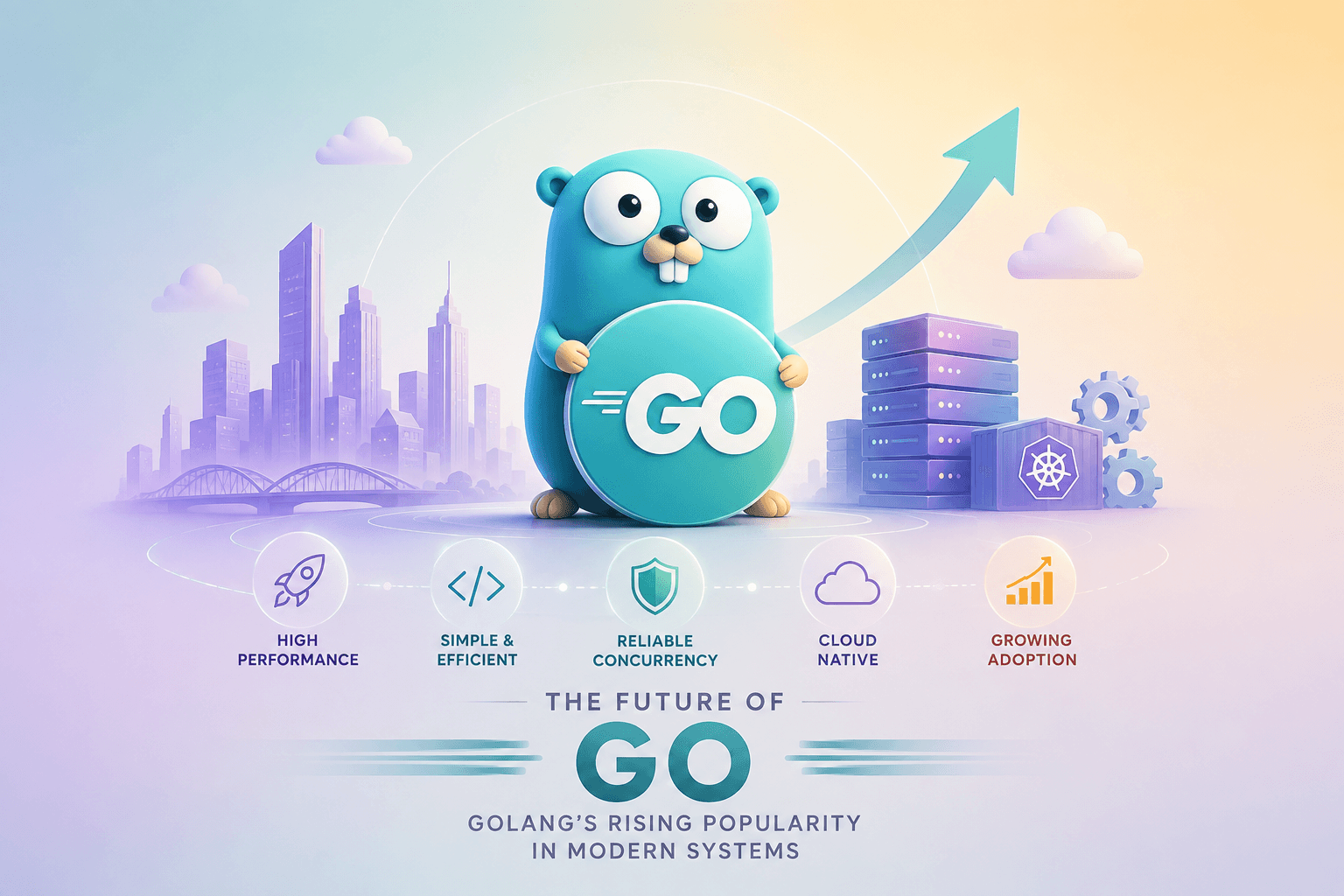
If you inspect the foundations of modern cloud infrastructure—Docker, Kubernetes, Terraform, Prometheus, Etcd, CockroachDB, and Caddy—you notice an unmistakable pattern: almost all of them are written in Go.
Created at Google in 2007 by Robert Griesemer, Rob Pike, and Unix co-creator Ken Thompson, Go was born out of intense frustration with C++ compilation times and the runaway syntactic complexity of enterprise object-oriented languages. Instead of asking what features could be added to a language, the Go designers asked what could be stripped away while preserving raw systems performance.
The CSP Concurrency Model: Goroutines vs OS Threads
Traditional systems languages handle concurrency by spawning operating system threads. An OS thread carries significant overhead: typically a 1MB to 8MB fixed stack, high context-switch latency mediated by the kernel scheduler, and dangerous shared-memory race conditions requiring defensive mutex locking.
Go implemented Tony Hoare's Communicating Sequential Processes (CSP) formal algebra through two primitives:
- Goroutines: User-space green threads managed by the Go runtime's
M:Nscheduler. A goroutine starts with a microscopic 2 KB stack that dynamically grows and shrinks on the heap as needed. A standard developer laptop can comfortably run 200,000 concurrent goroutines without running out of RAM. - Channels (
chan): Typed conduits through which concurrent goroutines synchronize and exchange data without shared memory: 'Do not communicate by sharing memory; instead, share memory by communicating.'
Practical Concurrency: A Production Worker Pool
Here is a canonical Go worker pool pattern demonstrating buffered channels, worker goroutines, and synchronized completion with sync.WaitGroup:
package mainimport ("fmt""sync""time")type Job struct {ID intURL string}type Result struct {Job JobStatusCode intDuration time.Duration}// worker processes incoming jobs concurrently from a shared channelfunc worker(id int, jobs <-chan Job, results chan<- Result, wg *sync.WaitGroup) {defer wg.Done()for job := range jobs {start := time.Now()// Simulate network fetchtime.Sleep(50 * time.Millisecond)results <- Result{Job: job,StatusCode: 200,Duration: time.Since(start),}}}func main() {const numJobs = 10const numWorkers = 3jobs := make(chan Job, numJobs)results := make(chan Result, numJobs)var wg sync.WaitGroup// Launch worker poolfor w := 1; w <= numWorkers; w++ {wg.Add(1)go worker(w, jobs, results, &wg)}// Enqueue workfor j := 1; j <= numJobs; j++ {jobs <- Job{ID: j, URL: fmt.Sprintf("https://api.service.internal/v1/resource/%d", j)}}close(jobs) // Closing signals workers to finishwg.Wait()close(results)for res := range results {fmt.Printf("Job %d completed with status %d in %v\n", res.Job.ID, res.StatusCode, res.Duration)}}
The Single Binary and Minimalist Tooling Advantage
The second reason Go dominates production infrastructure is its compilation model. Unlike Node.js or Python, which require megabytes of interpreter runtimes and complex virtual environments, go build produces a single, statically linked binary with zero external shared library dependencies.
In containerized deployments, this allows Docker images to be built FROM scratch or FROM alpine, resulting in images as small as 12MB. That means near-instant container startup times, minimal attack surfaces with zero CVEs from extraneous operating system utilities, and effortless CI/CD pipelines.