

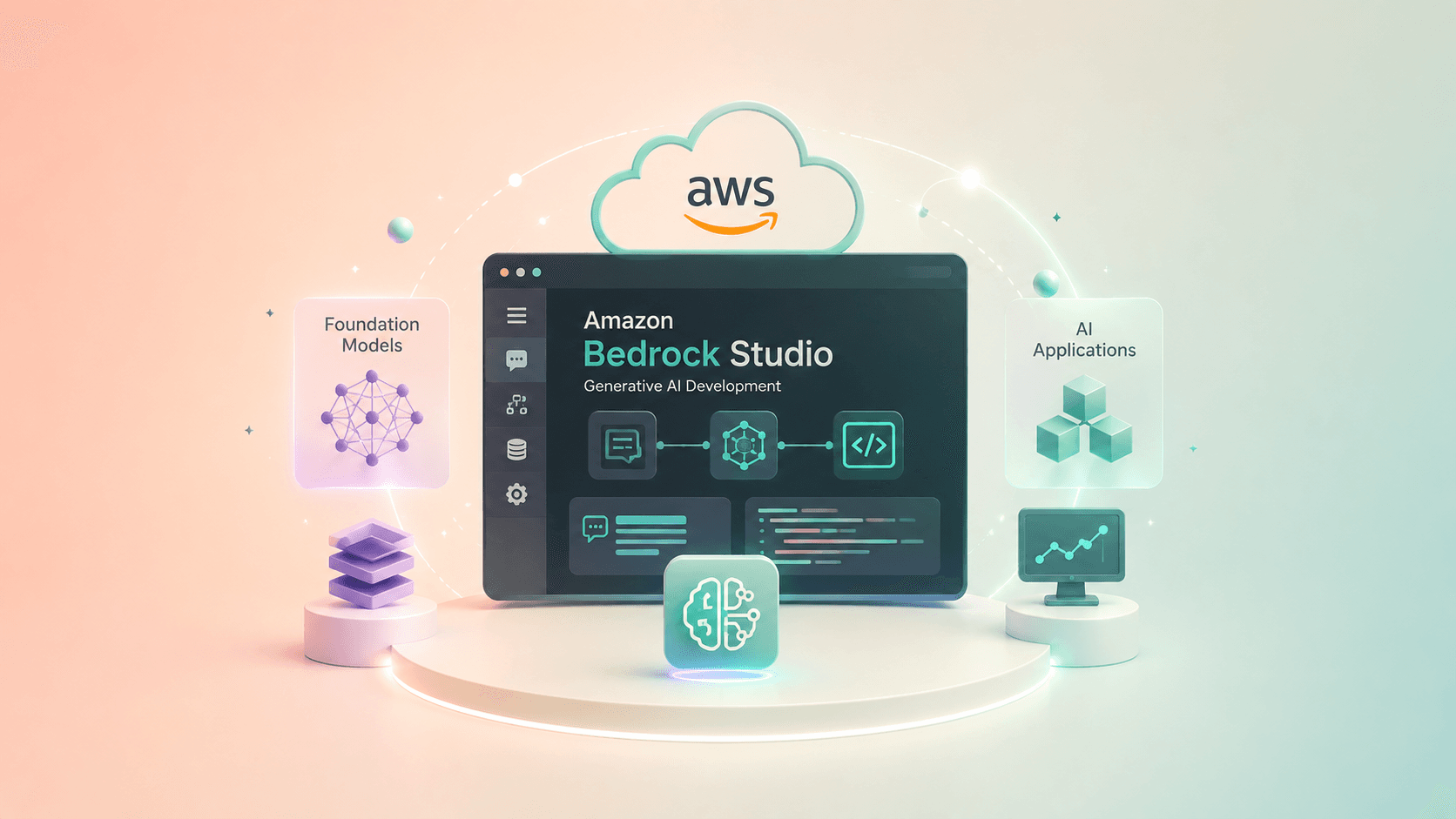
Amazon Web Services has launched Amazon Bedrock Studio, a web-based environment for building and experimenting with generative AI applications. It is currently in public preview, and it gives developers access to multiple foundation models, knowledge bases, AI agents, and guardrails from one place.
The interface walks developers through the steps: improving model responses, tweaking settings, integrating tools and APIs, and putting guardrails in place. Administrators set up one or more Bedrock Studio workspaces for their organization through the Management Console, then grant access to specific people or groups.
Antje Barth, a principal developer advocate at AWS, describes the flow as creating a workspace, adding the users you want to give access to, and sharing the workspace URL with them. Those users sign in through single sign-on, create projects, and start building.
Like Amazon SageMaker Studio, Bedrock Studio is a managed environment with no direct access to the underlying AWS infrastructure. Barth notes that when you build an application there, the resources it needs, such as knowledge bases, agents, and guardrails, are deployed automatically into your own AWS account, and you can reach them afterwards through the Amazon Bedrock API.
What is in it
- Support for AI agents.
- Multiple foundation models.
- Knowledge bases for retrieval-augmented generation, which return cited responses.
- Guardrails for implementing AI safety controls based on your use cases and policies.
The capabilities largely mirror the existing Amazon Bedrock offering. Monica Colangelo of NTT DATA argues the real value is the playground itself, which lets people experiment with all of these features together and lowers the barrier to entry considerably.
There is no additional cost for Bedrock Studio; customers pay only for their Bedrock usage. Colangelo does point out a limitation, which is that AWS IAM Identity Center has to be configured in the same region where Bedrock Studio is available.
Reactions have been mixed. Corey Quinn of The Duckbill Group commented wryly on potential pricing practices, while Jeremy Daly of Ampt said simply that "some of this stuff is getting scary good." Banjo Obayomi of AWS has published a demo video showing how the workspace operates.
The public preview is currently available in two US regions, Northern Virginia and Oregon.