

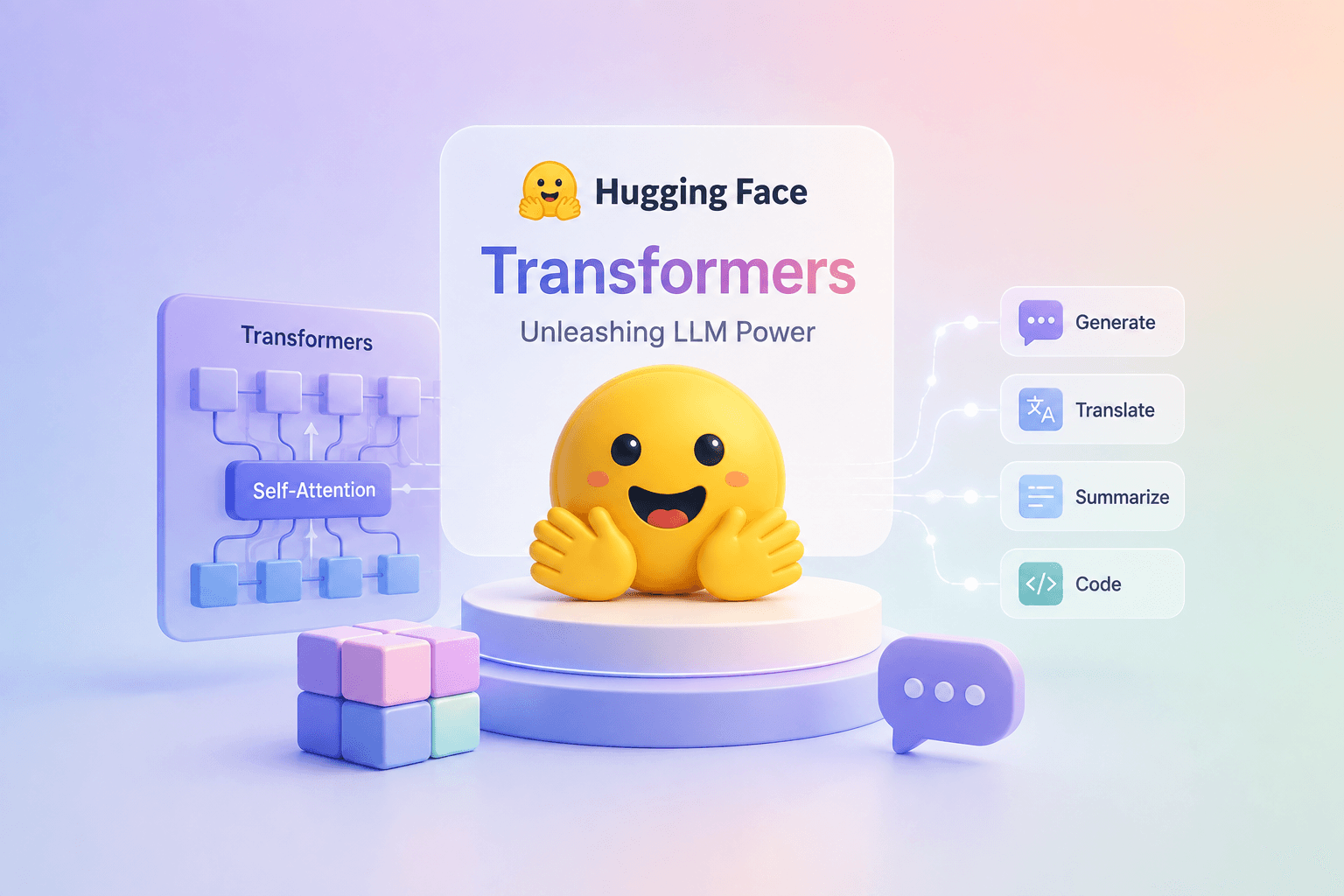
Large language models are changing how we process information, and Google's open-source Gemma is strong at tasks like question answering and creative text generation. Integrating one can be fiddly, though. This is how Hugging Face simplifies working with Gemma.
Hugging Face gives you a straightforward platform for exploring and using models like Gemma. That lowers the barrier considerably, and it is a large part of why so much collaborative AI work happens there.
What Gemma is good at
- Informative question answering. Useful answers to complex questions.
- Creative text generation. Narratives, scripts, or code from a prompt.
- Multilingual support. Translation between various languages.
Getting it running
The library does most of the work. Install it, then load a tokenizer and a model by name:
pip install transformers torch
This is the text-only pattern from the Transformers documentation, using a small Gemma checkpoint:
import torchfrom transformers import AutoModelForCausalLM, AutoTokenizertokenizer = AutoTokenizer.from_pretrained("google/gemma-3-1b-pt",)model = AutoModelForCausalLM.from_pretrained("google/gemma-3-1b-pt",device_map="auto",attn_implementation="sdpa")input_ids = tokenizer("Plants create energy through a process known as",return_tensors="pt",).to(model.device)output = model.generate(**input_ids, cache_implementation="static")print(tokenizer.decode(output[0], skip_special_tokens=True))
Two details in there are worth knowing rather than copying blindly. device_map="auto" lets the library place the model across whatever hardware you have, so the same script runs on a GPU or falls back to CPU without edits. And the -pt suffix means pretrained, which is the base model that continues text. For anything conversational you want an instruction-tuned checkpoint, the -it variants, because a base model will happily keep writing your prompt rather than answering it.
What you can build with it
With an API key and a small amount of code you can reach Gemma through Hugging Face and use it for:
- Research. Pulling insights out of large amounts of text.
- Chatbots. Building chat experiences that are engaging and actually informative.
- Content workflows. Automating the repetitive parts of content creation.
The choice worth making early is between running the weights yourself, as above, and calling a hosted inference endpoint. Local means no per-token cost and your data never leaves the machine, at the price of needing the hardware and the memory to hold the model. Hosted inverts both. For anything beyond a small checkpoint on a laptop, that is the decision that shapes the rest of the project.