

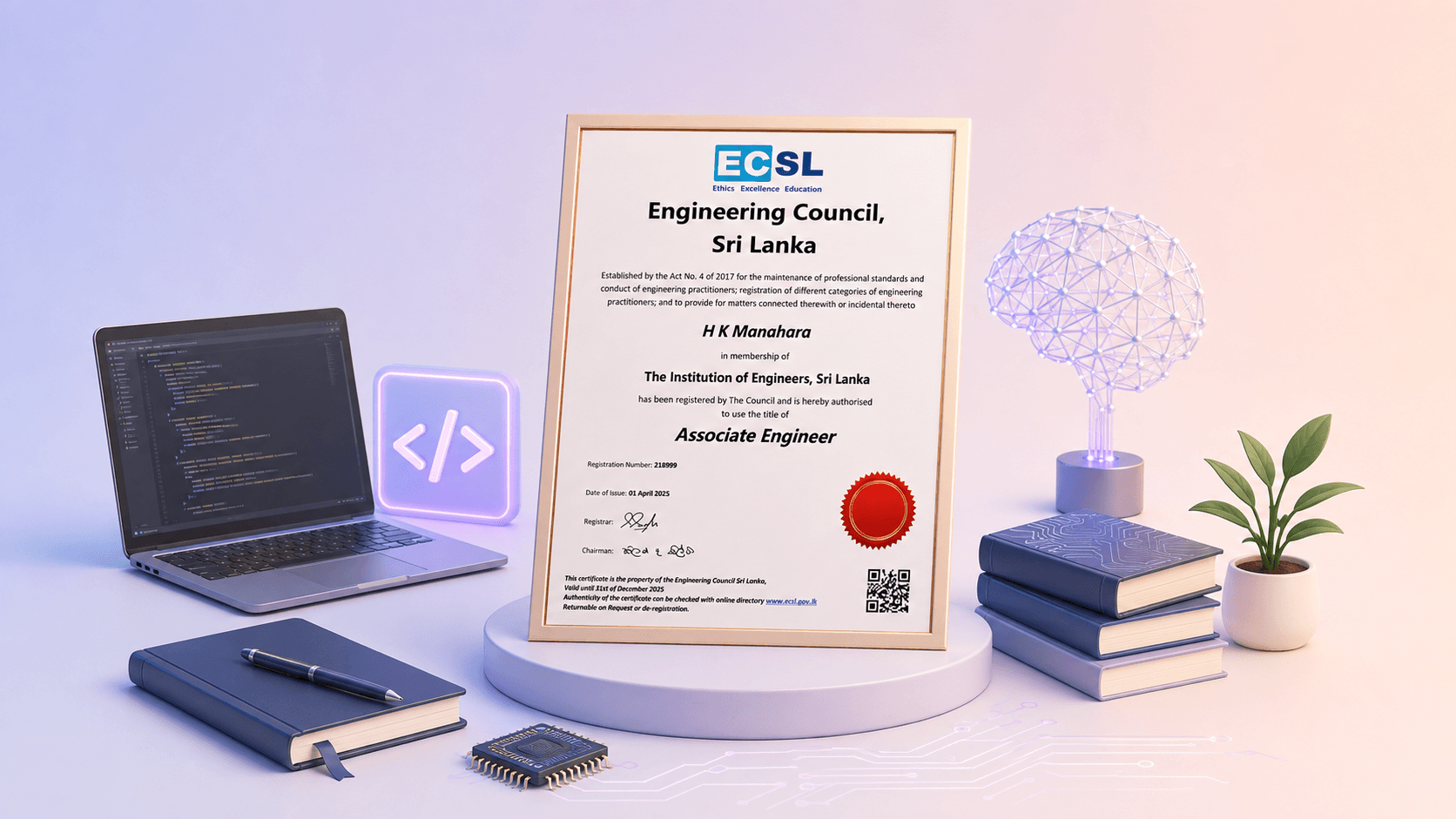
I am pleased to share an important milestone in my professional engineering journey: I have been officially registered as an Associate Engineer by the Engineering Council of Sri Lanka (ECSL).
In many parts of the tech industry, the title 'engineer' is used casually—often appended to frontend developers, prompt engineers, or sales specialists without formal statutory meaning. In Sri Lanka, however, the Engineering Council, Sri Lanka Act No. 4 of 2017 established a strict legal framework regulating the practice of engineering across all disciplines.
The Statutory and Academic Foundation
Under the ECSL Act, registration as an Associate Engineer recognizes individuals holding a four-year engineering honors degree from an accredited institution. For me, this is rooted in my graduation from the Department of Computer Engineering at the University of Peradeniya—a program accredited under the international Washington Accord by the Institution of Engineers, Sri Lanka (IESL).
That academic foundation was deeply rigorous. It wasn't just about learning high-level programming frameworks; it meant mastering computer systems architecture, operating systems internals, discrete mathematics, digital signal processing, electronic circuit design, and hardware-software co-design. That breadth builds an instinct for understanding exactly what happens when high-level code interacts with physical transistors and OS schedulers.
Why Engineering Discipline Matters in Modern Software and AI
As software systems become increasingly autonomous—powering critical health infrastructure, automated trading desks, and LLM agentic pipelines—the boundary between traditional civil/mechanical engineering and computer engineering blurs. When an AI pipeline hallucinates an automated medical recommendation or an asynchronous worker pool exhausts server memory during an emergency, the consequences are concrete and severe.
Statutory engineering registration reinforces three principles that guide how I build and write:
- Professional Accountability: A commitment to rigorous verification, defensive systems design, and root-cause analysis rather than superficial hot-fixes.
- Code of Ethics and Public Safety: Designing distributed systems with security, privacy, data protection, and fault tolerance as primary non-functional requirements.
- Continuous Professional Development (CPD): The ongoing discipline of keeping pace with rapidly evolving systems architectures, from Linux kernel developments to state-of-the-art agent protocols.
I look forward to continuing my journey as a practicing computer systems engineer, building high-reliability software, and documenting technical findings here on Space.